Study Structure
Traceability consists of “tracing” and “tracking”:
- “tracing” involves tracing the origin1 or the path of something or someone. This activity makes it possible to create a historical record across the value chain retroactively.
- “tracking” involves following something or someone along the value chain, looking toward its destination and anticipating what will happen in the future.
1 The concept of origin is not limited to the place of export of the finished product. For the purposes of this study, the origin (or origins) of a product is defined as the location where a process took place involving the product or its components (raw material extraction, manufacturing, assembly, etc.).
2 Returnable transport items
As part of this study, we are focusing on traceability:
- of means of transportation (trucks, trains, ships, barges, cargo bikes, etc.);
- equipment (pallets, tools, containers, carts, RTIs2, refrigerated units, etc.);
- goods (batches, individual packages, food products, medications, etc.);
- people (human resources or users of mobility solutions).
“Tracking” and “tracing” activities may involve identification or authentication technologies, location tracking, as well as monitoring of intrinsic or environmental parameters.
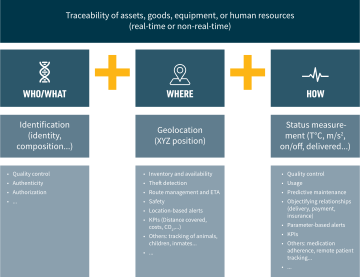
Generally speaking, the components of a traceability solution are:
- The generation of data (what/who, where, and status measurement);
- Data transmission (e.g., internal, external);
- Data storage (e.g., cloud, decentralized);
- Data processing (e.g., artificial intelligence);
- Creation of the user interface;
- The digitization of paper documents.
This study primarily covers the first four elements, for which a multitude of combinations is possible.

There may be several solutions available for the same type of application, and it will be necessary to clearly define the objectives and constraints of each situation in order to identify the best combination of technologies based on criteria such as cost-benefit, interoperability, and human factors…
The study is divided into four parts and includes appendices:
Technologies
The first part of the study includes a comparison of the various technologies, along with a brief description of each and examples of their applications.
Applications
The second part of the study examines various applications driven by business needs. This section begins by discussing the decision-making process, as well as the constraints and regulations that justify the implementation of traceability solutions.
Trends and Opportunities for Innovation
Part Three highlights certain trends and areas for innovation identified in the study.
Market Research
Part Four addresses, on the one hand, individual qualitative interviews and, on the other hand, the qualitative online survey.
Foreword by Gilbert Wellemans—Country Manager of Zetes Belgium
Since the start of the pandemic, delivery services have been put to the test, revealing latent weaknesses in the supply chain. At the same time, customers—now accustomed to online shopping—have become increasingly demanding when it comes to costs and delivery times.
During the lockdown, 65% of purchases were made online, compared to 34% previously. Belgians spent an average of €1,193, with an average of 15 orders per person. Bol.com, in particular, doubled its revenue in our country, while online sales of Belgian products from abroad rose by 10% overall.
In addition to the coronavirus, our sector has also experienced a major upheaval due to Brexit. This has led to an increase in customs duties—to the surprise of some consumers—and a restructuring of shipping routes on a global scale. This period of major upheaval calls for a restructuring of delivery logistics.
Furthermore, experts predict even more complications in the next two years. Traceability and visibility are therefore now major assets for companies looking to succeed. Anticipating significant spikes in orders, maintaining visibility into inventory, and accurately calculating delivery dates and times… Technology supports us every day as we move toward providing optimal services.
Gilbert Wellemans, Country Manager at Zetes Belgium
